Meteor Crater in Arizona
I stand on the edge of a vast bowl, shaped not by time and not by earthly forces, but by a single instant.
An instant when the sky collided with the Earth.
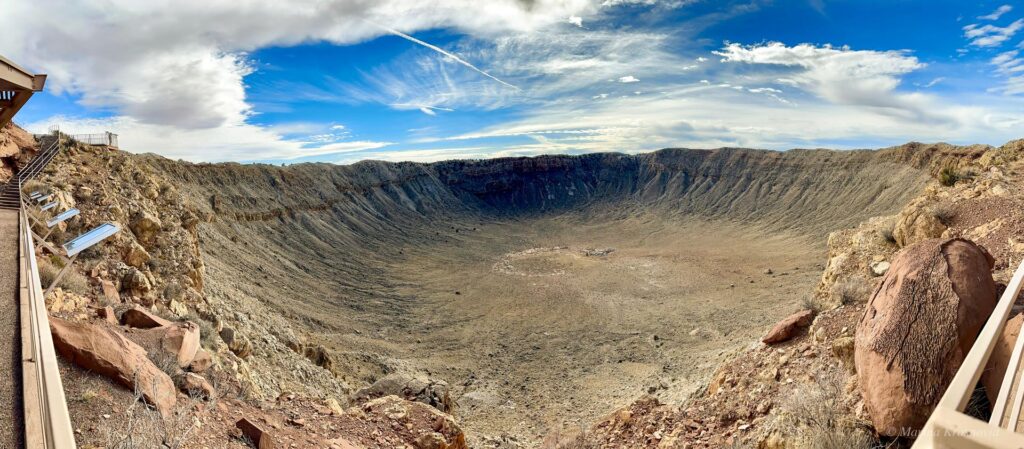
Before me lies Meteor Crater, also known as Barringer Crater. It is located roughly sixty kilometers east of Flagstaff, in northern Arizona. At first glance, it resembles a colossal amphitheater, as if carved out by a giant. Up to two million spectators could fit inside it. But this resemblance is deceptive. There was never a performance here.
There was an impact.
The crater measures about 1,200 meters in diameter and 170 meters in depth. Its surrounding rim rises approximately 45 meters above the desert plain. It is the best-preserved impact crater on Earth and the first one scientifically proven to be of extraterrestrial origin. For a long time, people believed it to be a dormant volcano. But it was not a volcano.
It was a visit from space.
When the Sky Struck the Earth
Around 50,000 years ago, at a time when woolly mammoths and saber-toothed cats roamed what is now Arizona, a visitor was approaching Earth. A nickel-iron meteorite, roughly 45 meters in diameter, was traveling at more than 46,000 kilometers per hour. It entered the atmosphere, ignited, heated to white-hot-and within fractions of a second released energy equivalent to ten megatons of TNT.
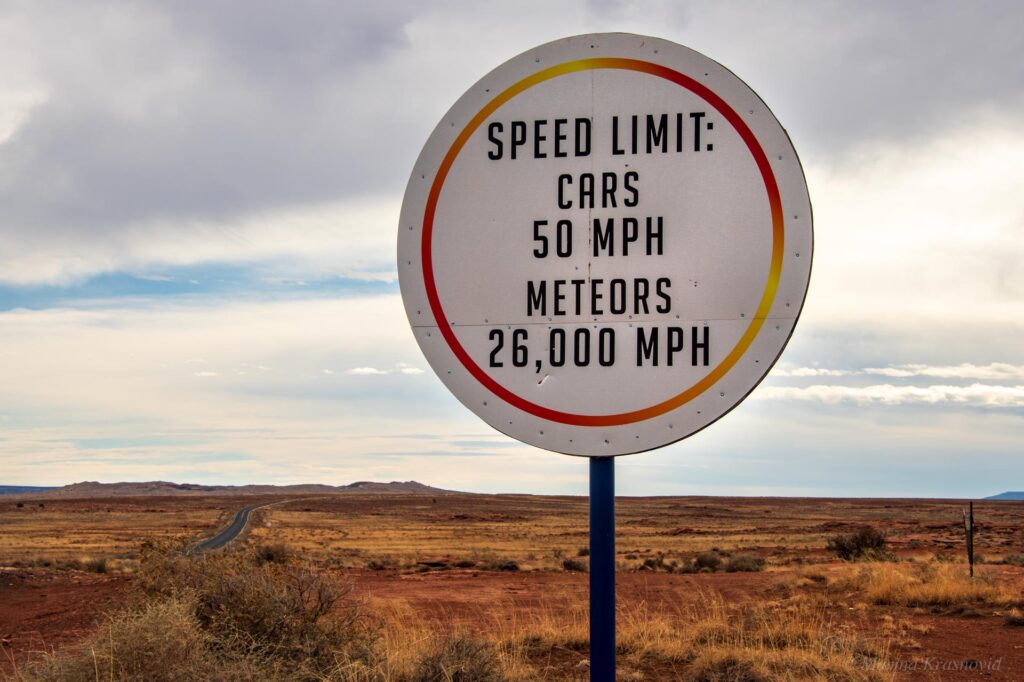
This was hundreds of times more powerful than the atomic bombs dropped on Hiroshima and Nagasaki.
The impact was so immense that the meteorite did not simply break apart. It was almost completely vaporized-transformed into gas and plasma-instantly melting and scattering Earth’s crust for kilometers in every direction. The ground convulsed, surged upward, and then froze, preserving this scar forever.
That is why, for decades, people searched beneath the crater for a nonexistent “iron mass.”
There was none.
Space Never Left – It Is Close
It is easy to believe that such events belong only to distant geological ages. But for me, this is not an abstract story.
In February 1984, in the Irkutsk region of Siberia, I was walking down a street. It was bitterly cold. The air was transparent, like glass. There was no wind, no sound-only the crunch of snow beneath warm felt boots. And then, above the horizon, light appeared.
Not just a bright object, but a massive fireball-blinding, as if someone had suddenly switched on a second sun.
It moved in silence. No explosion, no thunder-only a faint hum, as though the air itself was trembling with tension. The fireball left a glowing trail and vanished beyond the mountains. That was all. But I knew: I had witnessed something that reshapes the Earth.
Later, I learned that it was the Chulym bolide. Thousands of people across Siberia had seen it. Like the meteorite that created this crater, it entered the atmosphere, heated up, and disappeared before ever reaching the ground.
And now, standing on the rim of the crater in Arizona, I understand:
The universe did not strike the Earth once, long ago.
It continues to knock.
The Man Who Tried to Dig Up the Cosmos
At the beginning of the twentieth century, mining engineer and entrepreneur Daniel Barringer put forward a bold idea: the crater had been formed by a meteorite impact. At the time, most scientists believed such formations to be volcanic. But Barringer saw more than a scientific debate.
He saw opportunity.
He was convinced that beneath the crater lay a massive iron core weighing nearly ten million tons-cosmic iron, nickel, and platinum. In 1903, he estimated its value at one billion dollars-an almost astronomical sum for that era. Today, it would sound like someone claiming: “I have found a piece of Mars underground worth a trillion dollars.”
He invested everything. His family acquired the land along with its mining rights. Drilling began. Equipment was installed. Workers were hired. Plans multiplied. But Barringer did not know the essential truth: after an impact of this magnitude, a meteorite does not sink into the ground.
It disappears.
He drilled the crater for twenty-seven years. Money, health, time-everything went down into the Earth. By the onset of the Great Depression, his fortune had nearly vanished. In today’s terms, he lost approximately 9.5 million dollars. But the greatest loss was not financial. It was the loss of certainty. He stared into emptiness, unable to understand how the cosmos could have deceived him.
When the Earth Spoke in Quartz
Calculations eventually showed that the meteorite had vaporized. It seemed the story was finished.
But the Earth had left evidence.
In the mid-twentieth century, unusual rock samples from the crater came into the hands of Edward Chao. At first glance, they appeared to be ordinary quartz. But they did not behave as quartz should. Their density and optical properties did not match any known form.
Chao identified coesite, a polymorph of silicon dioxide that until then had existed only in laboratories. He then discovered stishovite, an even denser form of quartz, named in honor of Soviet physicist Sergei Stishov, who had first synthesized it artificially.
These minerals cannot form through volcanism or slow geological pressure. They appear only under instantaneous, extreme temperatures and pressures-conditions comparable to a nuclear explosion or an asteroid impact.
It was the Earth’s own confession.
The crater had been created by space.
From that moment on, scientists held a key. Wherever coesite and stishovite were found, ancient impacts came into focus. Craters around the world seemed to rise from beneath time itself.
Science, Business, and the Line Between Them
After the collapse of mining ambitions, the crater could have become almost anything. But then Harvey Nininger appeared – a dedicated meteorite hunter. He established a research station, collected samples, and gave lectures. The ruins of his station can still be seen along the road to the crater.
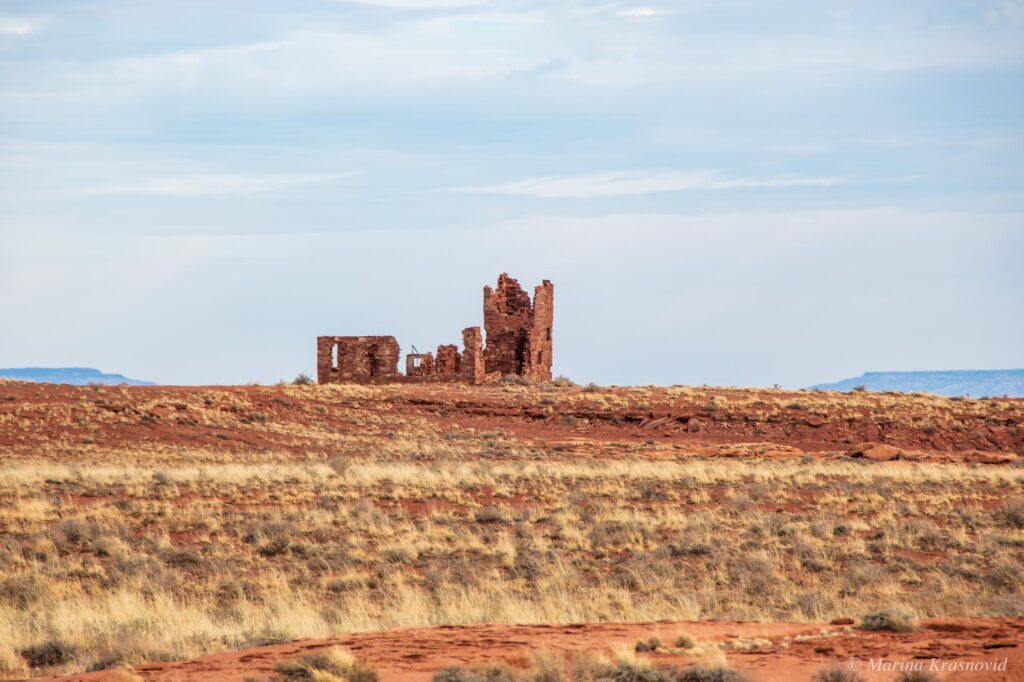
Nininger proposed turning the crater into a national monument. But the Barringer family saw this as a threat to private ownership. Nininger was stripped of his research rights, and soon a private museum appeared on the crater’s rim. Thus began a struggle between science and commerce-a struggle that continues to this day.
The Crater That Trained People for the Moon
In the second half of the twentieth century, a man arrived who transformed our understanding of impact craters – Eugene Shoemaker. He turned the crater into a laboratory of planetary catastrophes.
Here, he trained the first NASA astronauts-how to read impact rocks, how to collect samples, how to interpret landscapes shaped not by time but by an instant. Humanity’s path to the Moon began here, on the rim of this immense bowl.
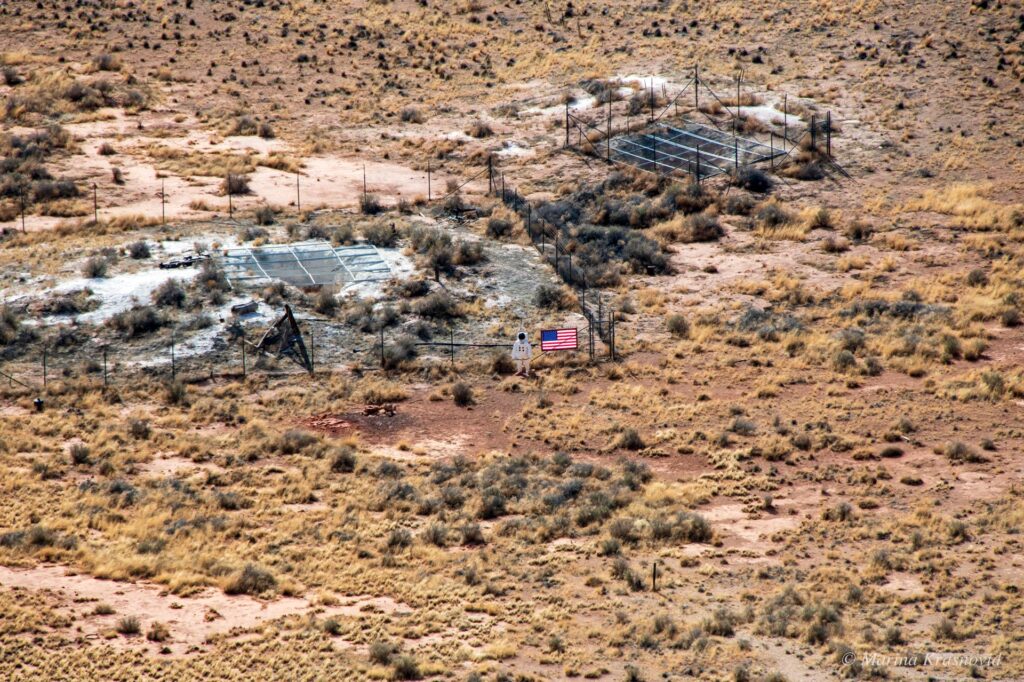
Shoemaker himself dreamed of walking on the Moon. But Addison’s disease took that possibility away. He devoted his life to searching for impact craters across the planet.
On July 18, 1997, he was killed in a car accident in Australia. But his story did not end there. A portion of his ashes was sent to the Moon aboard the Lunar Prospector spacecraft.
He became the only person whose remains rest on another celestial body.
Engraved on the capsule are Comet Hale–Bopp, Barringer Crater, and lines from Shakespeare:
“When he shall die,
Take him and cut him out in little stars…”
When the Sky Could Not Hold a Wing
On August 8, 1964, a Cessna 150 attempted to fly over the crater. Powerful air vortices pulled the aircraft inward. It could not escape, lost lift, and crashed into the crater wall. The pilots survived but were seriously injured. Some fragments of the wreckage remain visible at the bottom of the crater.
After that, unrestricted flights over the crater were banned.
Legends and the Whisper of the Wind
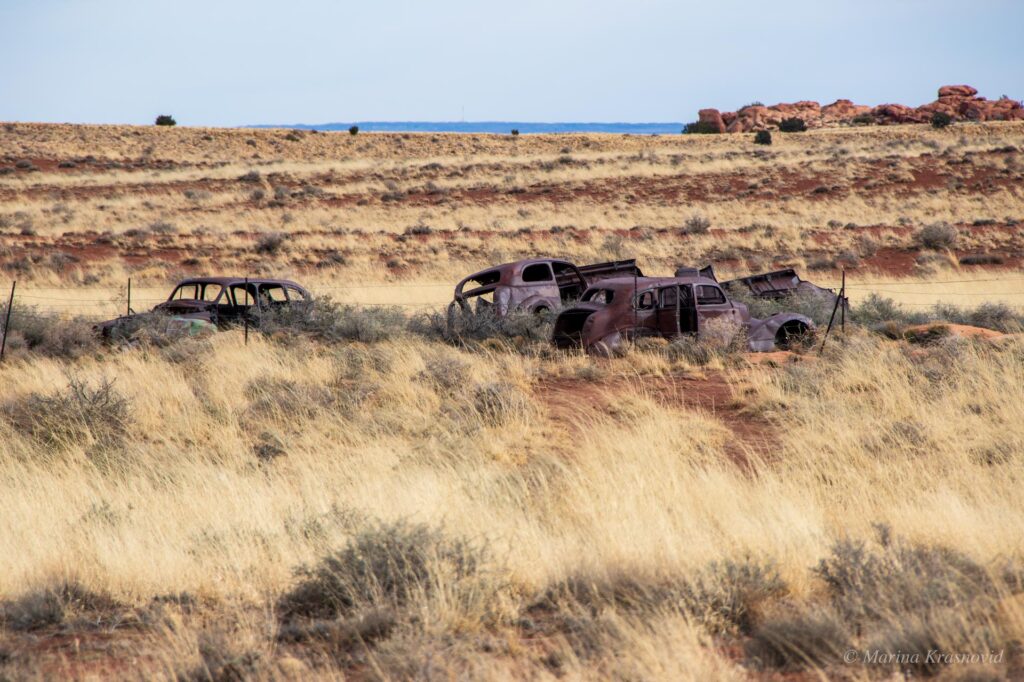
There are legends as well. It is said that in the late 1960s, a pair of tourists in a van drove too close to the crater’s edge-and the vehicle slid downward into the depths. Whether it was a hippie bus or merely a myth, no one knows. But this is a place where such stories sound entirely natural.
A Window into the Past and a Simulator for the Future
Today, astronauts continue to train here. The crater’s landscape closely resembles the surfaces of the Moon and Mars. This is not merely a tourist attraction. It is a textbook on how the universe shapes our planet.
The crater’s museum also features exhibits devoted to meteorite events in Russia, including the Chelyabinsk meteor of 2013-a reminder that space has not gone anywhere, and has no intention of leaving.
I stand on the rim of this vast bowl as the Arizona wind stirs the grass at my feet. The crater is silent, yet it speaks louder than thousands of pages of textbooks.
It reminds us:
The Earth is not sheltered beneath an iron sky.
Space is not somewhere “out there.” It is here.
And what fell once may fall again.
I know this not only from science. I saw it with my own eyes-on that freezing day in 1984, when a fireball pierced the Siberian sky and, for a brief moment, the world became cosmic.
Some stories continue in motion.
Others remain — in silence, light, and distance.
Beyond the words, the place reveals itself in motion and in stillness.
 EN
EN  RU
RU